
FedSubK Feature: The Acquisition Lifecycle of Service Contracts - Phase 3 Contract Administration & Closeout
Updated: May 4, 2024
This month we end our three-part series on the acquisition lifecycle of service contracts with an overview of the third and last phase, Contract Administration and Closeout (or “Post Award” Phase). (NOTE: Find Part 1 here and Part 2 here.)
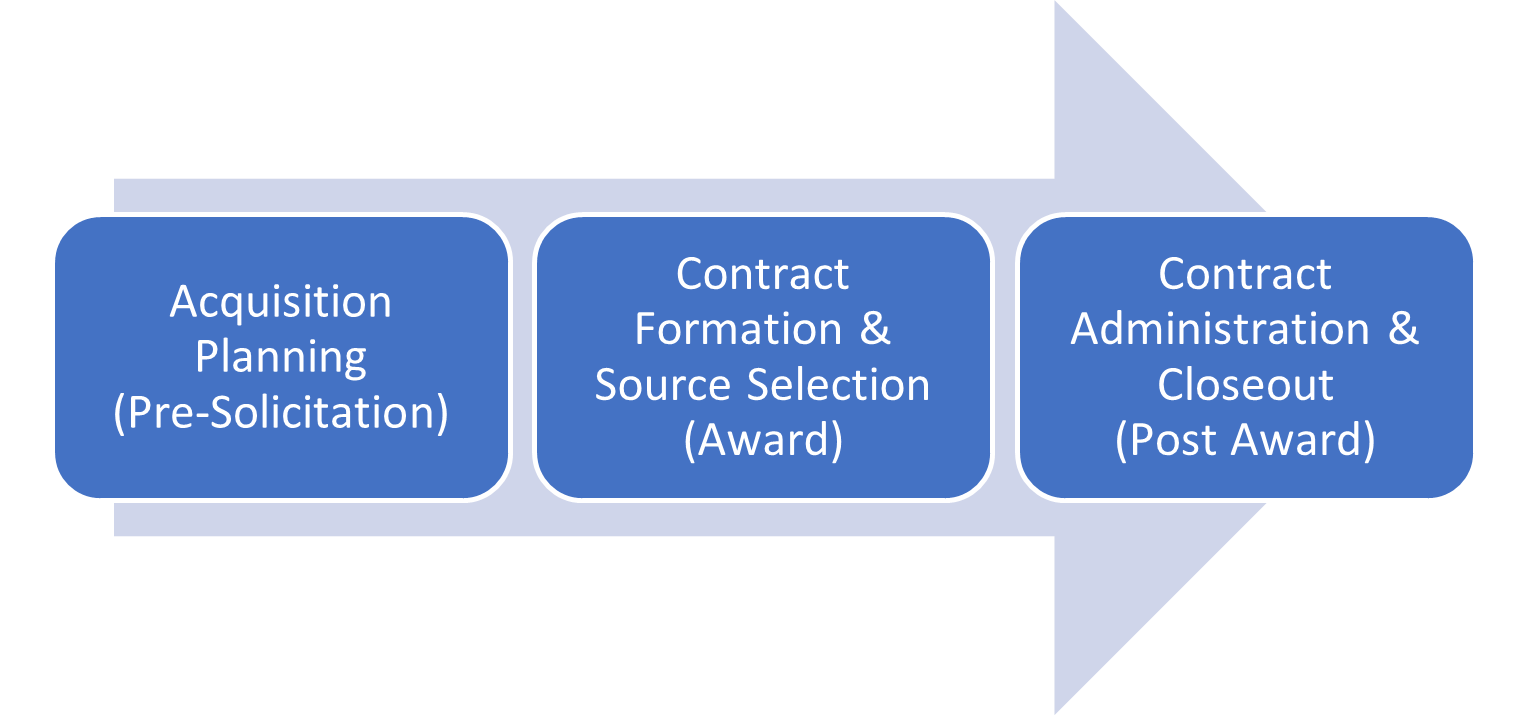
As before, we will talk about each subactivity in this phase but first, let’s review the lifecycle of a typical Federal services contract valued over the Simplified Acquisition Threshold (or “SAT,” presently $250,000).
Figure 1 – Acquisition Lifecycle
You’ve been selected as the awardee of a Federal contract! Congratulations! All that hard work paid off. But the fun isn’t over yet.
To see that pay out, you’ve got to perform. Yes, now you must back up that proposal by providing stellar performance of the requirements. That means providing the personnel promised in the proposal (i.e., Key Personnel), the deliverables necessary to begin performance, and continue building the relationship with your Federal client.
Contract Administration & Closeout (Post Award)
The Contract Administration and Closeout (Post Award) phase is where performance begins with the successful offeror now a Federal Prime Contractor (or “Prime”). The Government and Prime work together to ensure the performance, compliance, and reporting requirements are met and the end user receives the products and/or services required. Tasks are primarily performed by the Prime with Government oversight, acceptance, and performance evaluation.
Tasks in this phase are:
Figure 2 – Steps in the Contract Administration & Closeout (Post Award) Phase
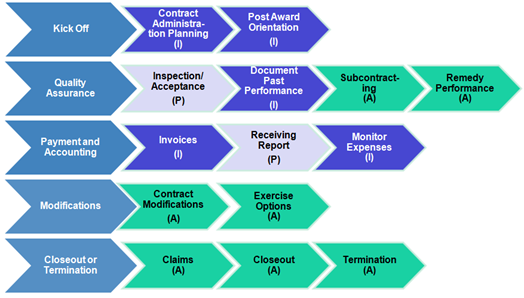
Legend: I = Integrated Project Team, P = Project Management Office / Requestor, and A = Acquisition Office
These tasks will culminate in a completed contract and closeout under which the Government and Prime agree that all deliverables (products or services) have been received, are acceptable, meet inspection criteria, and no further monies are due to the Prime or Government.
Key tasks in this phase and their impacts on the Prime are:
Kick Off Meeting (or “Post Award Conference”) (FAR Subpart 42.503)
The Kick Off Meeting is where contract administration planning and performance planning take place and a post award orientation meeting is conducted between the Prime and the Government. The CO/KO typically determines if and when a Kick Off Meeting is needed. The CO/KO will arrange the time and place, create the agenda, act as the meeting chair (or designate one), brief Government personnel before the meeting, and prepare a summary report of the meeting.
It is not the purpose of the meeting to change the contract. However, the Contracting Officer (CO/KO) may make commitments or give directions within the scope the CO’s/KO’s authority and the contract. The CO/KO must execute a formal written modification before the Prime takes action on such changes. If the chair is not the CO/KO, the chair is not authorized to commit the Government to any changes that impact scope, schedule, or price.
Often on large extraordinarily complex contracts, partnership agreements are developed and partnership meetings between the parties are held. Schedules and processes are agreed to for assurances that a positive relationship continues between the Government and Prime and to lay out how performance issues will be handled and escalated for resolution between the parties. For smaller contracts, a post award letter may be sufficient to outline requirements for communications and submission of deliverables if not already called out in the contract scope, terms, and/or conditions.
Subcontractors do not typically attend the Kick Off Meeting (Post Award Conference) between the Prime and the Government since the Government has no privity of contract with Subcontractors and vice versa. This is also when the Prime’s agreements with their subcontractor should be solidified if not done so already (NOTE: Primes can determine the clauses that flow down to their subcontractors from the solicitation document; little if anything will change in terms of clauses short of a new law or national initiative like a telecommunications ban, TikTok prohibition, or minimum wage increase (as we’ve seen in recent years).
The Prime may ask Government representatives attend the Prime/Subcontractor Kick Off Meeting and Government personnel may attend provided they: (1) remember the limitations in privity of contract, (2) take no action that alters a subcontract, and (3) ensure any changes that may impact the Prime contract with the Government are documented and reported to the CO/KO for further discussions with the Prime and resolution.
Quality Assurance (FAR Part 46)
The Government performs quality assurance through inspection/acceptance, documentation of past performance, monitoring the Prime’s subcontracting plan (if applicable), and coordinates on performance issues and set procedures to remedy any less than satisfactory performance.
Contract clauses for inspection and acceptance of services will be found in Part I, Section E of the solicitation under UCF. For fixed-priced contracts, FAR clause 52.246-4 Inspection of Services - Fixed-Price, requires that the contractor provide and maintain an inspection system acceptable to the Government covering the services under the contract. Other inspection and acceptance clauses exist for other types of contracts (see FAR Subpart 46.3). The Government has the right to always inspect and test all services and places during contract performance. FAR clause 52.246-4 specifically reserves the Government’s right to require reperformance by the Prime for nonconforming services at no cost or reduce the contract price if reduced services result in reduced value. It also puts the Prime on notice that if it fails to promptly perform the services again or to take the necessary action to ensure future performance is in conformance with the contract, the Government may have the serviced performed by others and charge the Prime for any costs incurred related to performance or terminate the contract for default.
Contracts for Commercial Products and Commercial Services
When acquiring commercial products under FAR Part 12, the Government relies on the Contractors' existing quality assurance systems as a substitute for Government inspection and testing before tender for acceptance, unless customary market practices for the commercial product being acquired include in-process inspection. Any in-process inspection by the Government is conducted in a manner consistent with commercial practice.
The Government relies on the Contractor to accomplish all inspection and testing needed to ensure that commercial services acquired conform to contract requirements before they are tendered to the Government.
Contracts aren’t without their share of “administrivia” type tasks. One of those tasks that is most important to the Prime is getting payments.
Payments and Accounting
Invoices must be submitted using the formats required by the Government, if applicable, and may sometimes be submitted electronically via an agency’s/organization’s financial system (i.e., Wide Area Work Flow (WAWF) for DoD, Corps of Engineers Financial Management System (CEFMS), or Vendor Inquiry Payment Electronic Reporting System (VIPERS) to name a few).
This step is CRUCIAL during performance; it is where you want to know your game plan and have your “A-Team” on the job. Why? Because delays in payment mean delays in getting capital to continue performance, pay subcontractors, order supplies, etc.
How often do you invoice? As often as the contract allows. They could be monthly for recurring monthly services, but most often is upon completion of task or deliverable as outlined in the deliverables and/or payment schedule. Other than Firm Fixed Price services may require that you also track costs and bill (and/or provided supporting documentation) in the form of hourly rates, hours expended, or agreed upon work breakdown structures (WBS) down to a specific level, depending on the type of contract (i.e., cost reimbursement, time-and-materials, or labor-hour).
The Government can turn away any invoice that is not considered a “proper” invoice (see FAR Subpart 32.905), meaning accurate, current, and complete with all information required by the agency to be submitted using the format they require (when indicated). Any delay pushes your payment back in the billing / accounts payable process. And when the delay in payment is because of the Prime’s error, there is no prompt payment interest involved (watch for a future FedSubK Feature on Prompt Payment coming in the May edition of FedSubK NOW!).
As mentioned, on complex type service contracts (i.e., cost, time-and-material, or labor-hour) you may have to track, segregate, and report hours, hourly rates, and total costs by line item and accounting string in your invoices or in attachments to support your invoice.
Modifications
Modifications ( sometimes referred to as "change orders") are issued when changes are needed as part of performance due to unforeseen circumstances, changes in conditions or assumptions, and mandatory statutory requirements come into effect. Contracting modifications are issued formally in writing by the Contracting Officer and are typically bilateral in nature, meaning the Prime must first sign the modification before the Contracting Officer signs. However, administrative modifications and modifications based on terms and conditions of the contract may be issued unilaterally, or with only the Contracting Officer’s signature.
Exercising Options
Options exercise the Government’s right to purchase more products or services at a pre-agreed pricing, extend services, or term the term of the contract. In the case of options, the Contracting Officer must supply written notice to the Prime of the Government’s intent to exercise an option within the period specified in the contract.
Options may only be exercised after a determination that all the following apply:
- Funds are available.
- The requirement covered by the option fulfills an existing Government need.
- The exercise of the option is the most advantageous method of fulfilling the
- government’s need, price and other factors considered.
- The option was synopsized per FAR Part 5 unless otherwise exempted.
- The contractor does not have an active exclusion record in SAM.gov (see FAR 9.405-1).
- The contractor’s past performance evaluations on other contract actions have been considered.
- The contractor’s performance on this contract has been acceptable, e.g., received satisfactory ratings.
After considering price and other factors, the Government must make a written determination that exercise of the option is in its best interest based on one of the following:
- A new solicitation would fail to produce a better price or a more advantageous offer than that offered by the option.
- An informal analysis of prices or an examination of the market shows that the option price is better than prices available in the market.
- The time between the award of the contract containing the option and the exercise of the option is so short that it indicates the option price is the lowest price obtainable or the more advantageous offer, considering market stability and comparison of the time since award with the usual duration of contracts for such supplies or services.
Other factors to be considered include the Government’s need for continuity of operations and potential costs of disrupting operations and the effect on small business.
There are two types of options that can extend the life of a contract. They are:
Option to Extend Services
As prescribed in FAR clause 52.217-8 of the same name, the Government may require continued performance of any services within the limits and at the rates specified in the contract (unless revisions are required to meet Department of Labor prevailing rates). This option may be exercised more than once, but the total extension of performance cannot exceed 6 months. The Prime must receive written notice of the Government’s intent to exercise an option to extend services within a period indicated in the fill-in found in the clause, most often 60 calendar days prior to the end of the current contract term.
Option to Extend the Term of the Contract
As prescribed in FAR clause 52.217-9 of the same name, the Government may exercise the option to extend the term of the contract with written notice to the Prime within a time period indicated in the fill-in found in the clause (most often 30 calendar days prior to the end of the current contract term). The Government must give a preliminary written notice of its intent to extend at least 60 days before the contract expires, unless a different number of days is inserted in the clause, though this notice does not commit the Government exercise the extension.
The clause also says that if the option is exercised that the extended contract is considered to include this same option clause and indicate the total duration of the contract, including the exercise of any options periods. Per FAR 17.204(e), unless otherwise approved in accordance with agency procedures and/or statute, the total of the basic period and all option periods cannot exceed 5 years in the case of services.
Performance is chugging along and you’ve come to the anniversary date of the contract. The Government exercises an option to continue performance. But the Government must also now rate the Prime’s performance at certain intervals.
Contractor Performance Assessment Rating System (CPARS)
CPARS is the Government’s official source for past performance information. Agencies must monitor compliance with the past performance evaluation requirements found under FAR Subpart 42.1502, and use the CPARS metric tools to measure the quality and timely reporting of past performance information for each contract that exceeds the SAT, or at such time a modification causes the dollar amount to exceed the SAT. For construction contracts, performance evaluations are required for contracts exceeding $750,000. For architect-engineer contracts, performance evaluations are required for contracts exceeding $35,000.
Past performance evaluations are prepared at least annually for multi-year contracts, and at the time the work under a contract or order is completed. Evaluations are generally for the entity, division, or unit that performed the contract or order. Past performance information shall be entered into CPARS by the Government and addresses, at a minimum, the following factors:
- Technical (quality of product or service).
- Cost control (not applicable for firm-fixed-price or fixed-price with economic price adjustment arrangements).
- Schedule/timeliness.
- Management or business relation
- Small business subcontracting, including reduced or untimely payments to small business subcontractors when a subcontracting plan is required.
- Other factors, as applicable, such as trafficking violations, tax delinquency, failure to report per contract terms and conditions, defective cost or pricing data, terminations, suspension and debarments, and failure to follow limitations on subcontracting.
Factors are evaluated and a supporting narrative is provided by the Government. Factors are rated with a five-scale rating system (i.e., exceptional, very good, satisfactory, marginal, and unsatisfactory). Ratings and narratives must reflect the definitions in the tables found at FAR Subpart 42.1503, Table 42-1 and Table 42-2 (when applicable).
Once entered by the Government, the Contractor will receive notification of a rating and can supply information for the record on any Government rating, comment, or feedback. If the Contractor does not agree with the CPARs rating, the rating still becomes available in the CPARS system for source selection officials to view not later than 14 days after the date on which the Contractor is notified of the evaluation’s availability for comment. The CPARS record is updated with any Contractor comments provided after 14 days as well as any subsequent agency of review of Contractor comments received. CPARS ratings are not subject to FAR protest procedures.
Agencies must use past performance information in CPARS. that is within three years (six years for construction and architect-engineer contracts) of the completion of performance of the evaluated contract or order, and information contained in the Federal Awardee Performance and Integrity Information System (FAPIIS), related to terminations for default or cause.
Contract Closeout or Termination
Contract closeout will occur once the Government makes its final inspection/acceptance and final payment has been made. Contract termination may also prompt an end to contract performance either for the convenience of the Government or due to the deficient performance of the contractor (“default”). Closeout of contract files can be a time-consuming process but is necessary to fully remove completed projects from the Government’s books. Termination, on the other hand, can be a quick process because it is most often reactionary in nature. Both require Government resources and Contractor cooperation to achieve results in a reasonable period.
Closeout
The closeout process is the process most all contracts will go through at the end of the performance cycle. Closeout is triggered by the physical completion of performance under a Federal contract. A contract is “physically completed” when the Contractor has completed the required deliverable and the Government has inspected and accepted supplies, the contractor has performed all services and the Government has accepted those services, and all option provisions, if any, have expired.
The Administering Contracting Officer (ACO), if one has been assigned, handles initiating administrative closeout after receipt of evidence of physical completion. If one has not been assigned, the Contracting Officer will act as the ACO to conduct the closeout. The ACO reviews the contract funds status and notifies interested parties (i.e., contractor, finance, and funding office) of any excess funds that require deobligation (i.e., removal from the contract by modification). Administrative closeout requires that the ACO ensures (as applicable)—
- Disposition of classified material is completed.
- Final patent report is cleared.
- Final royalty report is cleared.
- There is no outstanding value engineering change proposal.
- Plant clearance report is received.
- Property clearance is received.
- All interim or disallowed costs are settled.
- Price revision is completed.
- Subcontracts are settled by the prime contractor.
- Prior year indirect cost rates are settled.
- Termination docket is completed.
- Contract audit is completed.
- Contractor closing statement is completed.
- Contractor final invoice has been submitted.
- Contract funds review is complete and excess funds are deobligated (i.e., taken off the contract by formal written modification).
Files for contracts using simplified acquisition procedures should be considered closed when the ACO receives evidence of receipt of property and final payment, unless otherwise specified by agency regulations.
Files for firm-fixed-price contracts, other than those using simplified acquisition procedures, should be closed within 6 months after the date on which the ACO receives evidence of physical completion.
Files for contracts requiring settlement of indirect cost rates should be closed within 36 months of the month in which the contracting officer receives evidence of physical completion. Files for all other contracts should be closed within 20 months of the month in which the Contracting Officer receives evidence of physical completion.
The ACO will complete a Contract Completion Statement when all tasks are completed and forward the statement to the paying office of record. The paying office will close the contract file upon issuance of the final payment to the Contractor. Note that a contract cannot be closed if it is under litigation or terminations actions have not been completed.
Termination
The termination clauses along with other contract clauses authorize Contracting Officers to terminate contracts for convenience, or for default, and to enter into settlement agreements.
Whether for default or convenience, the Contracting Officer should only terminate a contract when it is in the Government’s interest. A no-cost settlement should be used instead of a termination notice when-
- It is known that the Contractor will accept one,
- Government property was not furnished, and
- There are no outstanding payments, debts due to the Government, or other contractor obligations.
When the price of the undelivered balance of the contract is less than $5,000, the contract should not normally be terminated for convenience but should be permitted to run to completion.
Terminations should only occur after written notification to the Contractor, whether for convenience or default. The notice will say the contract affected, effective date, extent of termination (partial or total), special instructions, and steps the contractor should take to minimize impact on personnel if the termination will result in a significant reduction in the contractor’s workforce.
After the Contracting Officer issues a notice of termination, the Termination Contracting Officer (TCO) (if designated) handles negotiating any settlement with the Contractor. Auditors and TCO’s must promptly schedule and complete audit reviews and negotiations, giving particular attention to the need for prompt action on all settlements involving small business concerns. In the interim, per FAR Subpart 49.104, the Contractor must—
- Stop work immediately on the terminated portion of the contract and stop placing subcontracts thereunder.
- Terminate all subcontracts related to the terminated portion of the prime contract.
- Immediately advise the TCO of any extraordinary circumstances precluding the stoppage of work.
- Perform the continued portion of the contract and submit promptly any request for an equitable adjustment of price for the continued portion, supported by evidence of any increase in the cost, if the termination is partial.
- Take necessary or directed action to protect and preserve property in the contractor’s possession in which the Government has or may acquire an interest and as directed by the TCO, deliver the property to the Government.
- Promptly notify the TCO in writing of any legal proceedings growing out of any subcontract or other commitment related to the terminated portion of the contract.
- Settle outstanding liabilities and proposals arising out of termination of subcontracts, obtaining any approvals or ratifications required by the TCO.
- Promptly submit the Contractor’s own settlement proposal, supported by appropriate schedules.
- Dispose of termination inventory, as directed or authorized by the TCO.
- In the case of terminated construction contracts, ensure the cleanup of the site, protection of serviceable materials, removal of hazards, and other action necessary to leave a safe and healthful site.
A subcontractor has no contractual rights against the Government upon the termination of a prime contract. A subcontractor may have rights against the Prime Contractor or ia higher-tier subcontractor with whom it has contracted. Upon termination of a prime contract, the Prime Contractor and each subcontractor are responsible for the prompt settlement of the settlement proposals of their immediate subcontractors.
For additional details regarding settlement agreements, see FAR Subpart 49.109 for Prime Contractors and FAR 49.108 for settlement of subcontract settlement proposals.
That’s it! You’ve just successfully finished your first Government contract for services. Now you’ve got experience, a new (and hopefully happy) Federal agency as a client, and confidence to continue pursuing more contracts and grow your space in the Federal marketplace. And not just winning a contract but understanding the process will show your commitment to serving your target client agencies and helping them be successful in their mission to provide products and services to the warfighter and/or the public.
.webp)
View related posts
The FAR is Changing. So Is the Way We Learn (Weathering the RFO - Part 7)
When I first became a contracting officer, there wasn't one place you learned federal acquisition.
You learned a little from the FAR. You learned from your supervisor. You learned from legal counsel after asking what felt like a hundred questions. You learned from experienced contracting officers who had already made the mistakes you were trying to avoid. You learned from GAO decisions, Inspector General reports, policy memoranda, training courses, and occasionally from acquisitions that didn't go quite the way anyone planned.
Over time, those experiences came together to form something that's difficult to define but easy to recognize. Professional judgment.
That's what separates someone who knows the FAR from someone who knows how to apply it.
As I work through reading the proposed rules on the Revolutionary FAR Overhaul (RFO), I keep coming back to one thought – which is something I learned as a Team Lead, a Branch Chief, a Chief, and an Acquisition Workforce Training Coordinator –
It’s not about writing a shorter FAR.
Throughout this series I’ve said it’s easy to focus on what has been removed from the FAR. Yes, we see a leaner document. But that’s not the biggest change.
The RFO separated regulatory requirements from implementation knowledge.
Today, acquisition professionals are working within a broader knowledge ecosystem than many of us grew up with.
1) While the FAR establishes the regulatory framework, the FAR Companion now provides the context for implementation of that framework.
2) Practitioner Albums now explain all of the thinking behind the changes and illustrate how the revised framework is intended to work in practice.
3) Agency deviations implement the revised structure while revisions continue and the RFO moves through the formal rulemaking process.
4) Agency supplements, policy memoranda, training resources, and professional education fill in the gaps.
It's a different model for how acquisition professionals access information.
Let Me Tell You A Story…
When I arrived at GSA in 2012, part of my job was training and developing a contracting staff of more than 50 people at different stages of experience and certification. In fact, part of the application process was developing an Acquisition Workforce Training and Development Plan. Apparently, that requirement scared everyone else away. I was the only person who applied.
My first few weeks taught me something else: GSA's acquisition policy and workforce information was scattered EVERYWHERE. Shared drives. Policy sites. Old documents. Poorly labeled documents. Finding what you needed was a nightmare.
About that time, GSA Administrator Dan Tangherlini launched the Great Ideas Hunt. I submitted an idea for an Acquisition Portal where GSA could bring workforce, career development, policy, FAR, DOL, small business and other acquisition information together. The idea took off, and I served on the working group that developed the site's hierarchy. The value was pretty simple: people could find the information they needed in one place.
The RFO just took that model and said – naw.
Instead it says, “We believe in you, Acquisition Workforce! While there is less of you and you’ve lost some of your historical knowledge, we know you can read and you will find the information you need no matter where we put it. Happy hunting!”
The Bigger Change Isn’t the FAR
For most of my federal career, if someone asked me where to start researching a procurement issue, my answer was relatively straightforward. "Let's start with the FAR." It didn’t mean that the FAR had the full answer, but it gave everyone a common starting point with enough context and process to get you going quickly. But today, I don't think that's enough.
Today, based on conversations with Contracting Officers I know still on the job, it sounds more like this: "Let's start with the FAR. Then let's see what the Companion says. Let's look at the Practitioner Album. Was there an Executive Order on this? Has OFPP issued guidance? Is there an agency deviation that applies? Has GAO weighed in? Has anyone done this in our group yet?"
That's not necessarily a bad thing. Eventually it could be a better way of supporting an acquisition workforce that has to learn to adapt more quickly than traditional rulemaking allows. But it does change some important things.
It changes how they learn. And it adds time and risk.
From the Contracting Officer’s Chair
Putting information somewhere the workforce can access it is not the same thing as developing the workforce. A Practitioner Album can explain something. A course can teach it. Neither necessarily teaches a GS-11 contract specialist when to question the answer, when discretion is appropriate, when to elevate something, or what downstream consequence a seemingly small acquisition-planning decision may create.
Some of the best contracting officers I've known couldn't quote FAR citations from memory. But they knew the questions to ask. They could see risk in an underdeveloped requirement before it became a solicitation problem. They understood how an acquisition-planning decision could affect competition months later. And they knew when to bring in legal counsel, small business, or technical experts.
That's judgment. And judgment comes from experience, mentorship, continuous learning and professional discussion, not simply knowing where to find the rule.
I do have some optimism about this new knowledge model. It can make acquisition guidance far more responsive than regulation alone ever could. I've seen firsthand how long FAR rulemaking can take. It can take YEARS. Meanwhile, technology changes, commercial practices evolve, GAO issues decisions, agencies act, and new buying techniques emerge. The FAR Companion and Practitioner Albums give the acquisition community a way to capture some of that evolution much faster. That's a positive.
But it also creates a challenge: Knowledge is only valuable if people know where to find it, what authority it carries, and when to rely on it.
One of the strengths of the FAR has always been consistency. Whether you worked at the DHS, U.S. Army Corps of Engineers, GSA, or another agency, everyone started from the same regulation. Today, knowledge is intentionally distributed across multiple resources. That means consistency depends less on where information is published and more on how effectively the acquisition workforce understands the relationship among those resources. That's a leadership challenge. And it's a training challenge.
Contractors, consultants, attorneys, and proposal professionals are adapting to the same knowledge ecosystem. Understanding where acquisition thinking now lives is becoming just as important as understanding the regulation itself.
Frankly, understanding the regulation, processes, and people all connect is one reason I’m still active in this field – even if I’m sitting on the industry side now. I could go chase my dream of being a photog, sell my prints, or get back to the art I've set aside for too long. But one of the things I enjoyed most about supervising contracting professionals was watching the moment when someone stopped looking for answers and started asking better questions. That's when I knew they were growing into their craft.
The FAR can teach requirements, but experience teaches judgment. And good supervisors accelerate that process. And if the RFO expects contracting professionals to exercise more judgment and discretion, then supervisors need tools specifically designed to help them develop that judgment in others. Give a developing specialist an acquisition and make them explain not just what they would do, but where they found the authority, what discretion exists, what alternatives they considered, and why they made the recommendation. Build that thought process into acquisitions at the lowest levels.
As I think about the RFO, personally, I don't worry nearly as much about whether a paragraph moved from the FAR to the FAR Companion. What I think about is the next generation of contracting officers.
How do we help them develop judgment in this new environment?
How do we make sure they understand not just what the regulation says, but why it says it?
To me, that's one of the most important leadership questions raised by the RFO. And who will help them. Too often, leadership does what it it has always done – writes the change and tosses it over the fence. That won’t cut it this time if they expect real change and innovation.
Moving so much of that practical knowledge outside of the FAR is a significant shift. How will we know how well the workforce is taking it all in? We need a structured mechanism for practitioners to identify recurring interpretation problems, conflicting implementation, useful practices, or places where the FAR Companion and Practitioner Albums need clarification.
That turns the workforce from passive recipients into part of the learning system.
Handled well, shifting process out of the FAR could create a more agile workforce. But handled poorly, it could create uncertainty, inconsistent implementation, and uneven professional development. At this point, I don't think we've seen enough to know which outcome is more likely. Jaime Gracia has been raising similar concerns about acquisition workforce development, including his recent article, “The Procurement Workforce Problem No One Wants to Fund” at https://www.linkedin.com/pulse/copy-procurement-workforce-problem-one-wants-fund-jaime-gracia-vdmke/?trackingId=BVgMVDCyRY6vwzJDfBYkwQ%3D%3D. There still aren’t enough people having this conversation.
It deserves more attention than it's receiving. And the acquisition workforce deserves more training and leadership support than it is getting.
Three Things Leadership Needs to Think About Now
• Create a common learning framework.
• Develop supervisors as the bridge between guidance and judgment.
• Measure whether implementation is actually producing consistent professional practice.
The RFO may have made the FAR leaner. It did not make federal acquisition simpler to learn.
-------------------------------------------------
What’s next? Weathering the RFO will be back as we work through the latest RFO proposed rules covering several “meaty” FAR parts. Watch for more soon on LinkedIn and Substack.
Author: Shauna Weatherly, President, Federal Subcontract Solutions LLC (dba FedSubK). Shauna is a small business advocate and owner of FedSubK. FedSubK exists to simplify federal contracting, empowering small businesses with practical, understandable resources. We bring first-hand experiences in Federal contracting from multiple perspectives derived from roles held both in and out of Government over almost four decades of Federal service.
Visit us at fedsubk.com to learn more about--
Getting Started in Federal Contracting: fedsubk.com/begin-your-journey-here
Solutions and Our Trusted Support Provider Network: fedsubk.com/solutions-services
Insights from a Contracting Officer: fedsubk.com/insights
Free Webinars and Resources: fedsubk.com/webinars-training
When Judgement Carries More Weight (Weathering the RFO - Part 6)
You've probably heard some version of this complaint about federal acquisition: "If they would just let the Contracting Officer use some judgment..."
Okay. I get that. But then what?
I bring this up because the Revolutionary FAR Overhaul (RFO) is stripping away some of the detailed implementation language that generations of acquisition professionals grew up with.
The idea, at least in part, is to create more room for acquisition professionals to exercise discretion and sound business judgment. I understand the theory. But as a former Chief of Contracting who was responsible for developing this employees with my limited training budget and limited resources but with more work than I could handle, what I can't stop thinking about is what happens when a Contracting Officer actually tries to use that discretion...but maybe doesn't have the experience or training to do so yet. As a Chief and having been responsible for acquisition workforce development, something I've seen is that process has a way of growing back.
Sometimes it comes from regulation. Sometimes it comes from agency policy. Legal counsel wants another review. A policy office creates another template. A contracting office develops a local procedure because something went wrong once five years ago.
And sometimes Contracting Officers do it to ourselves.
We keep doing something because that's how we've always done it. Because the template is already there. Because another approval makes everyone a little more comfortable. Or because trying something different means being the person who has to explain why (and right now, not many want to be THAT person).
That's where I think the "revolution" of the RFO is going to be tested. Having discretion and being COMFORTABLE exercising it are not the same thing. Neither is having discretion and being ALLOWED to exercise it.
A Contracting Officer may look at the RFO and see room for a different approach, but that CO/KO doesn't operate in isolation. There is a supervisor. Legal counsel. Program leadership. Agency policy. Review boards. Local procedures. Templates. Sometimes headquarters. Every one of those layers can influence how much of that theoretical flexibility survives an actual acquisition. That's not bad because checks and balances exist for a reason. I've spent enough time in those types of acquisition reviews to appreciate the value in a respected member of the team and leadership asking, "Have you thought about this?"
But there is a difference between oversight that improves an acquisition and the process that exists simply because it has always existed. And that raises a question I think agencies need to consider as the RFO moves forward: If we remove prescriptive process from the FAR and then recreate it through agency policy, local procedures, mandatory templates and layers of review, what exactly did we accomplish?
We could end up with a shorter FAR and essentially the same acquisition system. Or we could end up with something else entirely. We could have agencies and contracting offices rebuilding different versions of the processes that used to reside in one common regulation. That isn't flexibility. It could simply lead to more fragmentation.
From the Contracting Officer's Chair
What's not getting enough traction in this discussion is that detailed process provides training when no other training sources are available or exist. It gives the CO/KO something besides bureaucracy to hang their hat on. It also provides cover. Being able to say, "The FAR says..." is a pretty comfortable place for a CO/KO to stand when someone challenges an acquisition strategy.
But it's different when the answer becomes, "The FAR gives me discretion, and based on the market research, risk, requirement and facts of this acquisition, this is the approach I determined was appropriate right now." Now the CO's/KO’s judgment carries more weight. So does their signature. And that can freak out some less experienced COs/KOs.
I don't say that as a criticism of Contracting Officers. I've been one with an unlimited warrant for all types and dollar values of contracts. There is a reason experienced COs/KOs sometimes become cautious or risk averse. Acquisition decisions can be reviewed by a supervisor, legal counsel, an Inspector General, GAO, a court, or someone several years later who has the luxury of knowing how everything turned out. The experienced ones know that. That experience teaches you to think about not only whether you can make a decision, but whether you can explain and support it later in a way that the rationale is plainly understood by a "prudent person" at some future point in time. (Don't ask me how many times I still get calls asking if I remember why we wrote a period of performance or Section H term the way we did....it's a steady stream.)
That's why I don't think simply telling the workforce, "You have more flexibility now," will necessarily change acquisition behavior.
The system around the Contracting Officer has to permit that flexibility, too. And leadership has some decisions of its own to make related to that.
If we really want Contracting Officers exercising reasonable discretion, we have to accept something that comes with it: reasonable people will occasionally make different decisions. Two experienced Contracting Officers looking at similar acquisitions may choose different approaches. One may engage industry differently. One may structure the competition differently. One may decide a particular procedural step adds value while another decides it does not. That doesn't automatically mean one of them is wrong. It really comes down to whether the decision was lawful, reasonable, supported by the facts, and documented well enough that someone who wasn't sitting in the room can understand why it was made.
That's a different acquisition culture from one built primarily around procedural uniformity. And I'm not convinced yet that the Government is entirely comfortable with that distinction. Out of one side of its mouth as it touts this new "innovative thinking", procurement leaders and Think-Tanks say, "We trust you. Go forth and do great things." But out of the other is a culture that hasn't made the shift yet. Why? Because it's THE GOVERNMENT.
There is a natural tendency in large organizations to standardize. Something goes wrong, so we add a review. Someone makes a poor decision, so we create a template. An audit finds a weakness, so we establish another procedure. Individually, each response may make perfect sense. Collectively, that's how process grows back. That’s how we ended up with the FAR we had before the RFO. It grew the way it did because the FAR Council literally wanted to fix common mistakes through regulation and purposefully included detailed process and training for the sake of CONSISTENCY -- at the FAR level -- to avoid protests, risk, and a wild west culture in buying.
Five years from now, we could still find ourselves with a much shorter FAR but have it be surrounded by layers and layers of agency policy, local procedures, templates and unwritten rules that recreated much of what was removed.
If that happens, did we really change federal acquisition all that much? Or did we just inject chaos and inconsistency?
Industry should be watching, too. This isn't just an internal Government issue. If the RFO works as intended, industry will definitely encounter more variation among agencies, contracting offices and even individual acquisition teams as they make greater use of the discretion available to them. That makes meaningful market engagement even more important. And industry has already been complaining about the inconsistency in the application of the "old FAR" for decades. Just today we saw a small business set-aside announced on SAM.gov for 14 minutes from issuance to proposal cut-off. I mean, THAT'S WHAT WE ARE TALKING ABOUT HERE.
What does it mean for industry? Don't just tell the Government what you sell. You are going to have to help the acquisition team understand the market it is buying from. Explain what drives competition. Explain commercial practices. Explain what happens when requirements are bundled or structured a particular way. Explain where an acquisition strategy may unintentionally create cost, schedule, performance or competition risk for both parties. Give the Contracting Officer useful information on which to exercise judgment. Then let the Government (hopefully) make a good decision.
Industry can (and should) give the Government better information on which to base its acquisition decisions. I believe that will start to endear you to them. Not tell them what to do but what is going on in your world realistically and not just centered around you and your goals. Open their eyes.
As the RFO moves from rewriting regulations to changing actual acquisitions, I'm going to be really curious about what "grows back" and where when it comes to process -- way more than the number of pages the FAR may add down the road. (Oh, and I don't propose that -- or really care if -- every old procedural sentence eventually finds a new home somewhere else, either. That's not the point here.)
But you have to ask yourself--
• Will agencies resist the temptation to recreate deleted process through agency or local policy?
• Will contracting offices allow experienced COs/KOs to use the discretion the revised framework gives them?
• Will supervisors and reviewers support a reasonable decision even when it isn't the decision they personally would have made?
• Will Contracting Officers themselves become comfortable enough with that discretion -- and the accountability that comes with it -- to stop reaching for an old process simply because it feels safer?
Those answers will tell us if the RFO really "revolutionized" federal acquisition. (I still hate that adjective -- "revolutionary". It's so cheesy to use before you actually know; like saying it makes it so.)
And we can't forget how this is closely coupled with what is going on with the workforce in general with recent OPM changes. New organizations, reorganizations, new performance metrics, changed RIF structure, NDAs, and a culture of extreme politics in some organizations. We can't forget how those stressors and rules will weigh in on who steps up and goes first and who wants to be the test case for innovative judgement calls that may not go according to a clean E.O. or leadership vision. I don't see a lot of people raising their hands and where they are, what happens when things don't go "revolutionary" on the first try?
We've spent years saying federal acquisition needs more judgment and less process. Now we may finally get to find out whether the acquisition system -- and the culture -- is willing to or can live with what that actually means.
------------------------------------------------------------
What’s next? The RFO isn’t only changing the text of the regulation, it’s changing where knowledge sits. How does that impact learning a complex profession on the inside, and what does it mean to you in industry as you work with the acquisition workforce? Watch for the link to that article soon on LinkedIn.
Author: Shauna Weatherly, President, Federal Subcontract Solutions LLC (dba FedSubK). Shauna is a small business advocate and owner of FedSubK. FedSubK exists to simplify federal contracting, empowering small businesses with practical, understandable resources. We bring first-hand experiences in Federal contracting from multiple perspectives derived from roles held both in and out of Government over almost four decades of Federal service.
Visit us at fedsubk.com to learn more about--
Getting Started in Federal Contracting: fedsubk.com/begin-your-journey-here
Solutions and Our Trusted Support Provider Network: fedsubk.com/solutions-services
Insights from a Contracting Officer: fedsubk.com/insights
Free Webinars and Resources: fedsubk.com/webinars-training
How Early is "Early"? (Weatherly the RFO - Part 5)
"We need to engage the agency early."
It's hard to argue with that.
But what does "early" mean, actually? I mean – in Government terms and from their viewpoint.
Most companies are going to say “early” means before the solicitation is released. A lot of GovCons on LinkedIn talk all about getting in there while acquisition planning is going on. They say that’s the window when key decisions are made about contract types, competition pools, and evaluation factors. Others say it has to be well before acquisition planning.
Listen to those people!
They are the ones in industry that “get it”!
The best market research – and industry’s best opportunity to help inform the discussion – happens before acquisition planning formally begins.
Reading through the Revolutionary FAR Overhaul (RFO), and as a former KO/CO, I had hoped it would catch up and understand that “early" is too narrowly defined. Maybe I get it now from being out here in industry for a number of years fully immersed in the talk of capture and pipeline development.
Knowing the federal marketplace should be an ongoing acquisition competency, not an activity tied to a single procurement.
Technically, FAR Part 10 is gone but experienced contracting officers understand that market research and acquisition planning belong together. They influence each other constantly. From that perspective, integrating the regulatory text of FAR Part 10 into Part 7 recognizes that connection.
But putting market research in Part 7 may reinforce another problem; treating it as something that begins when acquisition planning begins. Market knowledge should lead acquisition planning, not begin with it.
A good requirement starts with knowing the market well. It’s when your Program Manager starts talking to you a good six months before the purchase request hits that a project is coming, prepping you for the drop. They give you intel on who the major players are, how commercial buying might fit, and outside influences like economic conditions or materials shortages.
From there, I can start talking to the Small Business Specialist and looking at the likely small business pool. I can talk with the estimator about likely dollar values and start thinking about contract type, pricing structure, clauses, and ways to streamline the procurement.
Right there.
Did you see that?
I’m already thinking about the competition pool, contract type, and pricing structure and there isn’t any talk about a purchase request or acquisition strategy yet. That’s what EARLY is. And when contracting is included in programmatic budget discussions, those wheels turn even earlier. And even with that six-month head start, it’s only useful if I’m not starting from zero.
And one thing the RFO is telling us very clearly now is that there is no requirement to conduct market research using a specific method or set of methods. There is no mandate to issue a Sources Sought or Request for Information (RFI).
The RFO doesn’t prescribe a method. It tells the acquisition team to conduct market research appropriate to the circumstances under certain scenarios, and to engage in responsible and constructive exchanges without creating an unfair competitive advantage or violating procurement integrity requirements. (Proposed rule RFO 7.201(b)).
The method isn’t the point anymore. The quality of the information and the judgment applied to it is.
With that I think a mindset shift needs to take place for the RFO to be successful. And when the FAR prescribes less about how to get that information, what the acquisition team already knows becomes more important, not less.
Look at market research as continuous learning, not a one-time action.
Industry watches markets continuously because it has to. Government acquisition teams tend to examine them one procurement at a time. Hopefully it's not just me that sees how that creates an information gap about the market before acquisition planning ever begins.
The market research contracting personnel are all familiar with is done to support an individual acquisition. It informs the strategy, contract type, commerciality determination, competition pool, pricing approach, and documentation supporting those decisions.
Continuous market learning does something different. It builds knowledge before there is an acquisition that demands it. It means understanding how an industry, its suppliers, technologies, pricing practices, and commercial business models are changing before a requirement forces us to ask.
So let’s get back to that word – “Early”
Earlier and more continuous engagement raises the obvious question about how does the Government keep it fair? The answer hasn’t changed. Engage ethically, document, protect procurement integrity, and don’t give individual firms an unfair competitive advantage.
Continuous market learning should never become continuous market favoritism.
In fact, broader and more continuous market awareness should make acquisition teams less dependent on what they learn from the handful of vendors who happen to show up for a particular procurement.
From the Contracting Officer's Chair
Using continuous market learning would create a focused ongoing procurement effort to understand industries, technologies, suppliers, and commercial business practices, whether or not an active procurement is immediately on the horizon.
Because of lumbering procurement timelines, many believe starting market research two years out is ample time to adjust to the market changes.
Yeah, I’ve fallen into that trap. It doesn’t work like that. Continuous market learning moves some of that discovery upstream, before changing direction becomes an acquisition problem. Or, as we call it in Contracting -- our problem.
Well-seasoned COs and KOs know instinctively continuous market learning is a much-needed best practice, but they aren’t always allowed to go to key industry events (because no travel funds), they don’t have time to meet with vendors (because of an end of fiscal year that goes on for an entire quarter), and they don’t have access to trade publications (because the Government won’t buy them a subscription). They try to pay attention to how markets are changing. But by the time the acquisition team discovers how much the market has changed, changing course can mean rethinking the solicitation, evaluation approach, competition strategy, and/or pricing structure. And anyone who has sat in the CO/KO chair knows the lift required to make those changes on an already compressed schedule.
The RFO’s FAR Companion says that “…acquisition teams should approach market research as an incremental process that builds understanding step-by-step.” That’s still looking at market research tied to an individual acquisition. The RFO writers had an opportunity to take the next step and distinguish procurement specific market research from continuous market learning. And they didn’t.
Ugh – heartbreaking!
But by integrating market research into acquisition planning in the text, and by relying more heavily on professional judgment, it creates space for the acquisition workforce to -- themselves -- think beyond procurement specific research to the possibility of continuous market learning. That gives agencies and programmatic teams within agencies a lot of leeway to create their own best practices.
If / how that happens is something to watch. BUT…
What the RFO Missed
RFO writers put their confidence in the acquisition workforce. Less prescription in process = more reliance on professional judgment. But judgment doesn't develop automatically with a new reg; I’ve been doing this long enough to know and live that. It comes from trusted and experienced leaders across the acquisition workforce – and by workforce I mean Contract Specialists (CS), COs, KOs, Contracting Officer’s Representatives (CORs), PMs, and Small Business Specialists. Those leaders step up and teach newer team members how to ask better questions, recognize bias, separate market understanding from vendor preference, and remain curious without compromising fairness in their research and engagements.
But the tools the RFO FAR Companion suggests aren’t starting points, not market knowledge. SAM.gov, CPARS.gov, FPDS.gov (which is now SAM Contract Awards and SAM Data Bank Reports), SBS, and other tools and datasets on Acquisition.gov and the GSA Acquisition Gateway don’t fully hit the mark. Talking to counterparts in other agencies, reviewing existing contract databases, reading industry publications, and examining vendor websites or online product literature are sources of information. They aren’t a substitute for market knowledge.
Useful? Absolutely. Enough? Not even close.
Tools provide data. Engagement provides information. Experience turns both into market knowledge.
A couple of things…
The question “Have we conducted market research yet?" isn't the same as "What do we know about the current market?"
The first asks whether an acquisition step has been completed. The second asks whether the acquisition team is informed.
The first is a report. The second can change an acquisition.
See the difference?
One of the unintended consequences of organizing market research as a separate FAR part was that it became easy to think of it as another acquisition milestone. Complete the market research, write it up, and move on and don't think about the market until the next buy.
The RFO has created an opportunity to break that habit. If we do break it, acquisition teams can begin acquisition planning informed by the market instead of using the start of acquisition planning to begin learning about it.
But, will we?
Acquisition Leaders – you have a challenge!
Five years from now, should market research still be something we conduct for an acquisition or will market knowledge finally be treated as a continuous learning acquisition workforce competency?
-------------------------------------------------------------------------------
Author: Shauna Weatherly, President, Federal Subcontract Solutions LLC(dba FedSubK). Shauna is a small business advocate and owner of FedSubK. FedSubK exists to simplify federal contracting, empowering small businesses with practical, understandable resources. We bring first-hand experiences in Federal contracting from multiple perspectives derived from roles held both in and out of Government over almost four decades of Federal service.
Visit us at fedsubk.com to learn more about--
Getting Started in Federal Contracting: fedsubk.com/begin-your-journey-here
Solutions and Our Trusted Support Provider Network: fedsubk.com/solutions-services
Insights from a Contracting Officer: fedsubk.com/insights
Free Webinars and Resources: fedsubk.com/webinars-training

