
FedSubK Feature: The Acquisition Lifecycle of Service Contracts - Phase 1 Acquisition Planning
Updated: May 4, 2024
This month we start a three-part series explaining why it is important for service contractors to understand the Federal acquisition lifecycle. Familiarizing yourself with the path you’ll walk to find, respond to, and possibly win Federal contracts is strategic. Two major advantages to businesses when they understand the lifecycle are:
● Strengthening Government Relationships. The ability to have meaningful conversations with the Government about your targeted contract actions and understand exactly where an action is in its lifecycle and the flow shows you appreciate the process and the work that goes into it from both the Government and industry perspective.
● Going In With Your Eyes Wide Open. Knowing the unique aspects of each phase in the lifecycle and its activities and sub-activities helps understand what the Government is doing and why at each phase. It pulls the curtain back and exposes the inner workings giving you the ability to be proactive, manage time and resources, and develop strategies to mitigate business risks during the process.
The lifecycle of a typical Federal services contract valued over the SAT involves three phases and many steps. The basic acquisition lifecycle for all contract actions is depicted below.
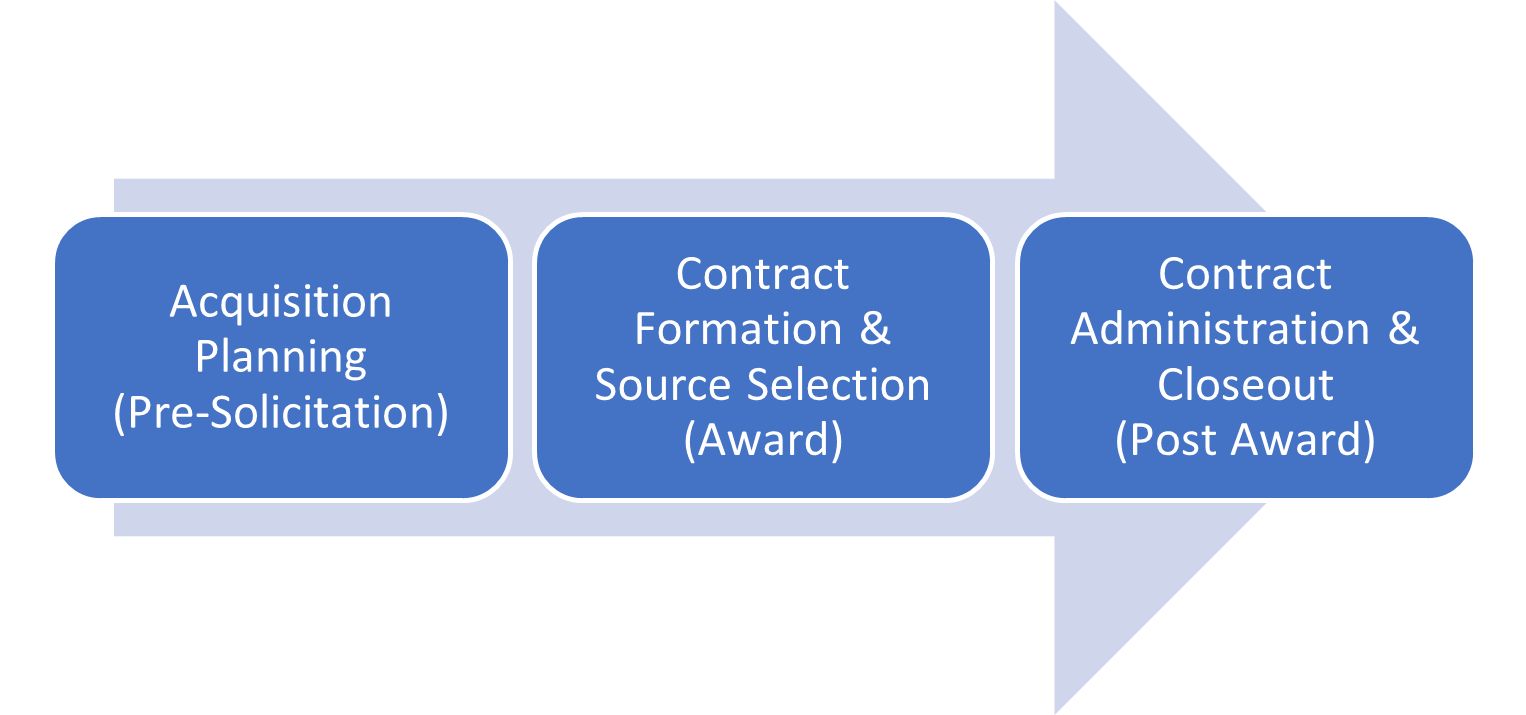
While the Government has several guides outlining either a 7-Step Process or 8-Step Process for Performance-Based Service Acquisitions (PBSAs), they focus heavily on the steps performed by the Government leading up to the solicitation of the requirement and not enough on the specific steps in the process wherein the offeror/contractor becomes involved after submission of an offer and contract execution. For that reason, our discussion will delineate those same processes using the three phases named above for clarity.
Acquisition Planning (Pre-Solicitation)
This phase is performed entirely by the Government before the issuance of the solicitation and includes input from industry as a result of market research efforts from the Government. Tasks in this phase include deciding--
● the Government’s need through market research, development of the acquisition strategy and/or acquisition plan, preparation of a random order of magnitude (ROM) or detailed Independent Government Cost Estimate (IGCE), and budget commitment.
● the Government’s requirements, including preparation of the statement of work (SOW), performance work statement (PWS), or statement of objectives (SOO).
● the extent of competition based on available competition pools and consideration of the use of set-asides to one or more of the Federal contracting assistance programs managed by SBA.
● the factors, criteria, and method of procurement to be used in the source selection process.
● the provisions and clauses for selection and use in the solicitation.
Steps in the Acquisition Planning (Pre-Solicitation) Phase

Legend: I = Integrated Project Team, P = Project Management Office / Requestor, and A = Acquisition Office
The steps, while depicted linearly, may be performed in tandem with those involved in the various steps of the pre-award phase. In the end, these tasks will culminate in an approved acquisition strategy and solicitation document to be published on SAM.gov.
Let’s discuss some specific elements of the Acquisition Planning phase for further understanding.
Market Research (FAR Part 10)
Market research is performed by the Government to “...arrive at the most suitable approach to acquiring, distributing, and supporting supplies and services.” Market research is always used, regardless of dollar value, but the extent of market research varies. Factors such as urgency, estimated dollar value, complexity, and the Government’s past experience making the same/similar purchases are taken into consideration.
A variety of market research techniques are available and may be used by the Government, taking into account the factors above and agency regulations and policy. They are:
● Contacting knowledgeable individuals in Government and industry regarding market capabilities to meet requirements.
● Reviewing the results of recent market research undertaken to meet similar or identical requirements.
● Publishing formal requests for information in appropriate technical or scientific journals or business publications.
● Querying the Governmentwide database of contracts and other procurement instruments intended for use by multiple agencies available at https://www.contractdirectory.gov/contractdirectory/ and other Government and commercial databases that provide information relevant to agency acquisitions.
● Participating in interactive, online communication among industry, acquisition personnel, and customers.
● Obtaining source lists of similar items from other contracting activities or agencies, trade associations or other sources.
● Reviewing catalogs and other generally available product literature published by manufacturers, distributors, and dealers or available online.
● Conducting interchange meetings or holding pre-solicitation conferences to involve potential offerors early in the acquisition process.
● Reviewing systems such as the System for Award Management (SAM.gov), the Federal Procurement Data System (FPDS), and the Small Business Administration's (SBA's) Dynamic Small Business Search (DSBS).
The Contracting Officer is allowed to use market research that is conducted within 18 months of an award for orders if the information is still current, accurate, and relevant. However, with large complex acquisitions that are recurring in nature (i.e., Governmentwide Acquisition Contracts (GWACs), Best in Class (BIC) contracts) it is not unheard of for market research to start anywhere from 24 to 30 months forward before the planned award date of a contract.
Acquisition Plan (FAR Subpart 7.105)
Aside from the statement of need, the contents of a written acquisition plan are lengthy at best. As someone who has written my fair share of acquisition plans and been the approving official on others, the list below shows the detailed considerations made by the Government when a written acquisition is required by the agency:
● Requirements for compatibility with existing or future systems or programs.
● Known cost, schedule, and capability or performance constraints.
● Life-cycle cost and how they will be considered, to include the cost model used.
● Design-to-cost objectives and underlying assumptions to include economic adjustment factors.
● Application of should-costs analysis to the acquisition.
● Required capability or performance characteristics.
● Basis for delivery or performance-period requirements.
● Trade-offs among the various cost, capability or performance, and schedule goals.
● Technical, cost, and schedule risks and efforts to reduce risk as well as the consequences of failure to achieve goals.
● Acquisition streamlining plans and procedures.
● Summary of prospective sources of supplies or services to meet the need to include:
-- Required sources of supplies and services (FAR Part 8).
-- SBA Federal Contracting Programs and use of set-asides.
-- Consolidation and bundling and how it may affect participation of small businesses.
-- Market research results.
● Competition requirements in terms of how it will be sought, promoted, and sustained through the acquisition lifecycle.
● Rationale for the contract type selected.
● Source selection procedures to be utilized.
● Acquisition considerations like multi-year contracting, multiple-award contracting, use of orders and/or options, other special contracting methods under FAR Part 17 to be used, special clauses or solicitation provisions, deviations, use of negotiated procurements, and/or lease or purchase of equipment.
● For Information Technology acquisitions:
-- Capital planning and investment control requirements.
-- Internet Protocol (IP) compliance requirements.
-- Accessibility standards.
● Budget estimates and funding sources.
● Product and service descriptions.
● Priorities, allocations, and allotments rationales for urgent requirements with a short delivery or performance schedule.
● Consideration of Office of Management and Budget (OMB) Circular No. A-76 regarding contractor versus Government performance of the work.
● Determination that the work is not inherently governmental (i.e., must be performed by a Government employee due to the nature of the duties performed or work requirements).
● Management systems that will be used to monitor the contractor’s effort, including Earned Value Management Systems (EVMSs) and the methodology to be employed to analyze and use the data to assess contractor performance.
● Make or buy decisions.
● Test and evaluation programs to be employed.
● Logistics considerations.
● Indication of any Government-furnished property to be used during performance.
● Environmental and energy conservation objectives and the applicability of any environmental assessment (EA) or environmental impact statement (EIS) on performance.
● Security considerations to include dealing with classified information, cybersecurity, physical security, and control of data to include Privacy Act Data.
● Contract administration procedures to be used including inspection and acceptance, enforcement of performance criteria, quality assurance, and identification of critical items.
● Other considerations, as applicable, such as:
-- Standardization concepts.
-- Industrial Readiness Program.
-- The Defense Production Act.
-- The Occupational Safety and Health Act.
-- The Support Anti-terrorism by Fostering Effective Technologies (SAFETY) Act of 2002.
-- Foreign sales implications.
-- Special considerations for contracts performed in a designated operational area or supporting a diplomatic or consular mission.
● Additional information related to major systems development or production contracts.
● Milestone schedule for the acquisition cycle.
● Identification of participants in the preparation of the acquisition plan.
FAR Subpart 37.102(a) dictates that performance-based acquisitions are the preferred method for acquiring services (Pub.L. 106-398, section 821) and must be used to the maximum extent practicable except for architect-engineer services, construction, utility services, and services that are incidental to supply purchases.
Did you realize that the Requiring Activity and Contracting Officer documented all those considerations? The Acquisition Plan is the “go-to” document when questions come up later in the acquisition process. I can’t tell you how many times as a Contracting Officer I had to remind the team when someone would get an idea to evaluate some new factor or change the competition pool – “What does the Acq Plan say?”
Competition Requirements
With certain limited exceptions, Contracting Officers are to promote and provide for full and open competition in soliciting offers and awarding Government contracts. Those exceptions include:
● Establishing or Maintaining Alternative Sources
Agencies may exclude a particular source because doing so would increase or maintain competition and likely result in a reduced overall cost for the acquisition, be in the interest of national defense, ensure the continuous availability of a reliable source of supplies or services, satisfy projected needs based on a history of high demand or satisfy a critical need for medical, safety, or emergency supplies.
● SBA Federal Contracting Assistance Programs
To fulfill the statutory requirements related to small business, 8(a), HUBZone, SDVOSB, WOSB, or EDWOSB concerns, contracting officers may set aside solicitations to allow only those businesses to compete with no separate justification needed to do so.
● Other Than Full and Open Competition
The Government may also use other statutory authorities to support other than full and open competition. The Department of Defense, Coast Guard, and National Aeronautics and Space Administration are subject to 10 U.S.C. 3204. Other executive agencies are subject to 41 U.S.C.3304. Contracting without providing for full and open competition or full and open competition after exclusion of sources is a violation of statute unless allowed by one of the exceptions below.
-- Only one responsible source and no other supplies or services will satisfy agency requirements. (FAR Subpart 6.302-1)
-- Unusual or compelling urgency. (FAR Subpart 6.302-2)
-- Industrial mobilization; engineering, developmental, or research capability; or expert services. (FAR Subpart 6.302-3)
-- International agreement (FAR Subpart 6.302-4)
-- Authorized or required by statute (FAR Subpart 6.302-5)
-- National security (FAR Subpart 6.302-6)
-- Public interest (FAR Subpart 6.302-7)
Solicitation Terms and Conditions
Solicitation terms and conditions are prescribed by the FAR and agency FAR supplements (see FedSubK Feature - Agency Supplements: The FAR and Its Child Regulations for more info on FAR supplements). A tip for understanding why a clause is included in a solicitation or contract is to read the prescription and any cross-reference material the prescription points to in the FAR.
The prescription for each provision or clause is found in FAR Part 52.2 and stated before each clause. For example:
Clicking on the hyperlink for the prescription will take you to the FAR subpart that explains the applicability of the clause and likely references to further information related to the clause and compliance.
Terms and conditions-like statements may also be found in the Statement of Work (SOW), Performance Work Statement (PWS), or Statement of Objectives (SOO) about site security, safety, badging, facilities access, and more. Be sure to understand those requirements as well as the compliance and reporting requirements of FAR provisions and clauses.
Under the Christian doctrine, a mandatory government contract clause that was not included in a government contract may be assumed included in the contract by operation of law, even when the clause is not written into or referenced by the contract. For example, under the Christian Doctrine, if the Buy American Act clause was inadvertently left out of a construction contract, the Act still applies to the Federal contract.
Summary
There’s a lot involved in the acquisition planning for a solicitation. Sometimes these steps take years to many months for major systems and highly complex acquisitions. For smaller or routine purchases, they can be accomplished in a matter of 45-90 days. But each new contract for services follows the same general Acquisition Planning (Pre-Solicitation) path.
The next time you talk to the Government about an upcoming acquisition, you can ask about where in the process the action is and know the path ahead. Next month we will talk about the next phase of the acquisition lifecycle; Contract Formation & Source Selection (Award).

View related posts
FedSubK Feature: The Real Challenge to Implementation of the GSA AI Clause
GSA's new artificial intelligence clause is now in effect, and while I support the government's efforts to protect its data, I have concerns about how this requirement will be implemented at the contracting officer level. Those concerns go well beyond the technology itself.
I recently joined Chelsea Roberts and Jaime Gracia on GovCon Unscripted to discuss GSAR 552.239-7001, Basic Safeguarding of Data Within Large Language Model Artificial Intelligence Systems. Our conversation focused on what the clause actually requires, who it affects, and what happens when contracting officers are left to interpret requirements that are not particularly clear.
Having spent nearly four decades in federal acquisition, including time as a contracting officer and chief of contracting, I tend to look at new policies through a practical lens. How will the contracting officer apply this requirement? What information will they need to make a defensible determination? And what happens when the government and contractor disagree?
Those are the things Contracting Officer's are talking to me about along with lack of training, implementation consistency, and who is their technical expert on this subject?
A Necessary Protection, but an Uncertain Application
Now, look...GSA does deserve credit for listening to industry. The original proposed language raised legitimate concerns that practically any contractor using AI could become subject to requirements intended for AI providers. The revised clause narrows that application considerably.
It now focuses on situations where large language model functionality is a "material feature" of what the government is acquiring and government data will be submitted directly to or produced by the system. It also provides exceptions for certain internal contractor uses and incidental commercial functionality. That's progress.
But... the word material is doing a HUGE amount of work in the text of the clause.
What makes AI a material feature rather than an incidental capability? Does that determination depend on the contractor's proposed solution, how the requiring activity describes its needs, or the contracting officer's interpretation? Who other than the contracting officer is responsible for the technical read on compliance?
Generally speaking, "material" means "significant" or "substantial".
Conversely, the clause also says it does not apply if AI is merely "incidental" or "ancillary".
Word salad? Maybe.
From the contracting officer's chair, I see the high potential for inconsistent application across procurements, even when agencies are acquiring similar services.
Discretion Without Clarity Has Consequences
We've spent years advocating for contracting officers to have greater discretion. I'm generally supportive of that approach. However, discretion works best when acquisition professionals have training, clear policy objectives, sufficient technical knowledge, and the tools necessary to exercise sound business judgment.
AI presents a particular challenge because contracting officers are not necessarily technical experts in how these systems operate. They depend on requiring activities, technical specialists, legal counsel, and cybersecurity personnel to help define requirements and assess risks. The problem arises when THOSE participants have different understandings of what constitutes material AI functionality.
Two contracting officers could reach different conclusions about essentially the same solution. So could two project managers or two requiring activities. One might include the clause, while another determines it does not apply. Both could believe their decisions are reasonable. And some will just stretch the truth to make it work for them and the contracting officer will be none the wiser.
That uncertainty doesn't simply disappear when the solicitation is issued. It transfers to industry.
Industry Will Price the Uncertainty
This was an important part of our podcast discussion that Jaime and Chelsea discussed. Contractors price risk.
When a solicitation leaves uncertainty about compliance obligations, data protections, subcontractor responsibilities, or future changes to the technology, businesses must decide whether to absorb that risk, increase their prices, seek clarification, or decline to compete.
And for small businesses, the consequences can be particularly significant. A company offering an innovative AI-enabled solution may lack the legal, cybersecurity, and contract administration resources needed to interpret and manage these obligations. Larger companies may be better positioned to absorb the costs.
The unintended result could be fewer competitors, higher prices, and reduced participation by the very technology firms the government wants to attract.
And consider GSA's Multiple Award Schedule program.
If contractors must account for additional compliance and administrative costs, will those costs affect the discounts they can reasonably offer the government? That's my concern as a former instructor of MAS Contracting to agencies. We teach agencies that they are required to request a discount for orders over the simplified acquisition threshold. Sometimes you get them and sometimes you don't -- they are at the schedule holder's discretion to grant. But how many actual discounts will we see now?
That's a legitimate acquisition consideration, a legitimate project budgeting and funding concern, and not simply an industry complaint.
Who Owns Compliance After Award?
Another concern is contract administration. The clause establishes obligations involving government data, incident reporting, subcontractor oversight, and changes to AI systems. These requirements extend well beyond the initial decision to include the clause.
Who will monitor compliance? Who evaluates whether a change to an AI model is material? Who determines whether a contractor has satisfied its responsibilities when an underlying technology provider changes its system?
A contracting officer can administer contractual requirements, but that doesn't mean the contracting officer independently possesses the technical expertise to validate every aspect of AI performance and compliance. They rely heavily on their Contracting Officer's Representative (COR) and technical staff. In 2012, GSA has consistently had Office of Inspector General (OIG) audits of its COR cadre and the work they do -- I know, I was interviewed by the OIG for one of those reports as an acquisition workforce training and development coordinator and senior contracting officer at the time for a major GSA portfolio.
Successful implementation will require significant coordination among contracting, technical, cybersecurity, legal, and program personnel within a GSA stovepipe, across GSA as a whole, and with GSA's customer agencies who place orders against GSA Schedules.
That's right! This isn't a "just GSA thing"... that clause is going to be incorporated into MAS Schedules effective Refresh #34. That impacts agencies Governmentwide.
That coordination needs to be established before implementation -- and we already missed the boat there. So now we are left with playing catch up, waiting on training, and still trying to do the right thing prior to award to avoid improvising when something goes wrong during performance.
From the Contracting Officer's Chair
My concern isn't that GSA is moving too quickly to protect government data. That protection is necessary.
My concern is that we may be placing significant interpretive and administrative responsibilities on contracting officers without providing enough consistency in how those responsibilities should be exercised.
The clause is currently implemented through a GSAR class deviation (RGO-2026-01), not a completed rulemaking process. That provides an opportunity to learn from implementation and make necessary improvements. GSA should use that opportunity to develop practical guidance, realistic acquisition examples, and clearer boundaries around applicability and administration.
Industry also has a responsibility to ask questions early, identify where the clause creates uncertainty, and provide meaningful feedback about its operational and pricing effects.
Together, Government and industry should be encouraging responsible AI adoption, not creating another layer of acquisition uncertainty that create risk and increases prices. Protecting government data and maintaining a competitive federal marketplace are not competing objectives. With thoughtful implementation, we can accomplish both.
GSA took the first step by listening. But now what? Where's the training? Where's the further communication with industry? Will they share lessons learned?
But -- in all of that -- we have to pay attention to what happens at the contracting officer's desk, because that's where acquisition policy becomes acquisition practice.
----------------------
Shauna Weatherly is the founder and president of Federal Subcontract Solutions LLC (FedSubK), a former federal contracting officer and chief of contracting, and a federal acquisition educator and commentator.
Watch the GovCon Unscripted discussion: GSA's AI Clause Hits Oct. 19: Who Decides If It Applies to You?
The contracting officer is where policy and implementation guidance becomes reality. Has GSA prepared its workforce -- and the rest of Government -- for that reality adequately?
The FAR is Changing. So Is the Way We Learn (Weathering the RFO - Part 7)
When I first became a contracting officer, there wasn't one place you learned federal acquisition.
You learned a little from the FAR. You learned from your supervisor. You learned from legal counsel after asking what felt like a hundred questions. You learned from experienced contracting officers who had already made the mistakes you were trying to avoid. You learned from GAO decisions, Inspector General reports, policy memoranda, training courses, and occasionally from acquisitions that didn't go quite the way anyone planned.
Over time, those experiences came together to form something that's difficult to define but easy to recognize. Professional judgment.
That's what separates someone who knows the FAR from someone who knows how to apply it.
As I work through reading the proposed rules on the Revolutionary FAR Overhaul (RFO), I keep coming back to one thought – which is something I learned as a Team Lead, a Branch Chief, a Chief, and an Acquisition Workforce Training Coordinator –
It’s not about writing a shorter FAR.
Throughout this series I’ve said it’s easy to focus on what has been removed from the FAR. Yes, we see a leaner document. But that’s not the biggest change.
The RFO separated regulatory requirements from implementation knowledge.
Today, acquisition professionals are working within a broader knowledge ecosystem than many of us grew up with.
1) While the FAR establishes the regulatory framework, the FAR Companion now provides the context for implementation of that framework.
2) Practitioner Albums now explain all of the thinking behind the changes and illustrate how the revised framework is intended to work in practice.
3) Agency deviations implement the revised structure while revisions continue and the RFO moves through the formal rulemaking process.
4) Agency supplements, policy memoranda, training resources, and professional education fill in the gaps.
It's a different model for how acquisition professionals access information.
Let Me Tell You A Story…
When I arrived at GSA in 2012, part of my job was training and developing a contracting staff of more than 50 people at different stages of experience and certification. In fact, part of the application process was developing an Acquisition Workforce Training and Development Plan. Apparently, that requirement scared everyone else away. I was the only person who applied.
My first few weeks taught me something else: GSA's acquisition policy and workforce information was scattered EVERYWHERE. Shared drives. Policy sites. Old documents. Poorly labeled documents. Finding what you needed was a nightmare.
About that time, GSA Administrator Dan Tangherlini launched the Great Ideas Hunt. I submitted an idea for an Acquisition Portal where GSA could bring workforce, career development, policy, FAR, DOL, small business and other acquisition information together. The idea took off, and I served on the working group that developed the site's hierarchy. The value was pretty simple: people could find the information they needed in one place.
The RFO just took that model and said – naw.
Instead it says, “We believe in you, Acquisition Workforce! While there is less of you and you’ve lost some of your historical knowledge, we know you can read and you will find the information you need no matter where we put it. Happy hunting!”
The Bigger Change Isn’t the FAR
For most of my federal career, if someone asked me where to start researching a procurement issue, my answer was relatively straightforward. "Let's start with the FAR." It didn’t mean that the FAR had the full answer, but it gave everyone a common starting point with enough context and process to get you going quickly. But today, I don't think that's enough.
Today, based on conversations with Contracting Officers I know still on the job, it sounds more like this: "Let's start with the FAR. Then let's see what the Companion says. Let's look at the Practitioner Album. Was there an Executive Order on this? Has OFPP issued guidance? Is there an agency deviation that applies? Has GAO weighed in? Has anyone done this in our group yet?"
That's not necessarily a bad thing. Eventually it could be a better way of supporting an acquisition workforce that has to learn to adapt more quickly than traditional rulemaking allows. But it does change some important things.
It changes how they learn. And it adds time and risk.
From the Contracting Officer’s Chair
Putting information somewhere the workforce can access it is not the same thing as developing the workforce. A Practitioner Album can explain something. A course can teach it. Neither necessarily teaches a GS-11 contract specialist when to question the answer, when discretion is appropriate, when to elevate something, or what downstream consequence a seemingly small acquisition-planning decision may create.
Some of the best contracting officers I've known couldn't quote FAR citations from memory. But they knew the questions to ask. They could see risk in an underdeveloped requirement before it became a solicitation problem. They understood how an acquisition-planning decision could affect competition months later. And they knew when to bring in legal counsel, small business, or technical experts.
That's judgment. And judgment comes from experience, mentorship, continuous learning and professional discussion, not simply knowing where to find the rule.
I do have some optimism about this new knowledge model. It can make acquisition guidance far more responsive than regulation alone ever could. I've seen firsthand how long FAR rulemaking can take. It can take YEARS. Meanwhile, technology changes, commercial practices evolve, GAO issues decisions, agencies act, and new buying techniques emerge. The FAR Companion and Practitioner Albums give the acquisition community a way to capture some of that evolution much faster. That's a positive.
But it also creates a challenge: Knowledge is only valuable if people know where to find it, what authority it carries, and when to rely on it.
One of the strengths of the FAR has always been consistency. Whether you worked at the DHS, U.S. Army Corps of Engineers, GSA, or another agency, everyone started from the same regulation. Today, knowledge is intentionally distributed across multiple resources. That means consistency depends less on where information is published and more on how effectively the acquisition workforce understands the relationship among those resources. That's a leadership challenge. And it's a training challenge.
Contractors, consultants, attorneys, and proposal professionals are adapting to the same knowledge ecosystem. Understanding where acquisition thinking now lives is becoming just as important as understanding the regulation itself.
Frankly, understanding the regulation, processes, and people all connect is one reason I’m still active in this field – even if I’m sitting on the industry side now. I could go chase my dream of being a photog, sell my prints, or get back to the art I've set aside for too long. But one of the things I enjoyed most about supervising contracting professionals was watching the moment when someone stopped looking for answers and started asking better questions. That's when I knew they were growing into their craft.
The FAR can teach requirements, but experience teaches judgment. And good supervisors accelerate that process. And if the RFO expects contracting professionals to exercise more judgment and discretion, then supervisors need tools specifically designed to help them develop that judgment in others. Give a developing specialist an acquisition and make them explain not just what they would do, but where they found the authority, what discretion exists, what alternatives they considered, and why they made the recommendation. Build that thought process into acquisitions at the lowest levels.
As I think about the RFO, personally, I don't worry nearly as much about whether a paragraph moved from the FAR to the FAR Companion. What I think about is the next generation of contracting officers.
How do we help them develop judgment in this new environment?
How do we make sure they understand not just what the regulation says, but why it says it?
To me, that's one of the most important leadership questions raised by the RFO. And who will help them. Too often, leadership does what it it has always done – writes the change and tosses it over the fence. That won’t cut it this time if they expect real change and innovation.
Moving so much of that practical knowledge outside of the FAR is a significant shift. How will we know how well the workforce is taking it all in? We need a structured mechanism for practitioners to identify recurring interpretation problems, conflicting implementation, useful practices, or places where the FAR Companion and Practitioner Albums need clarification.
That turns the workforce from passive recipients into part of the learning system.
Handled well, shifting process out of the FAR could create a more agile workforce. But handled poorly, it could create uncertainty, inconsistent implementation, and uneven professional development. At this point, I don't think we've seen enough to know which outcome is more likely. Jaime Gracia has been raising similar concerns about acquisition workforce development, including his recent article, “The Procurement Workforce Problem No One Wants to Fund” at https://www.linkedin.com/pulse/copy-procurement-workforce-problem-one-wants-fund-jaime-gracia-vdmke/?trackingId=BVgMVDCyRY6vwzJDfBYkwQ%3D%3D. There still aren’t enough people having this conversation.
It deserves more attention than it's receiving. And the acquisition workforce deserves more training and leadership support than it is getting.
Three Things Leadership Needs to Think About Now
• Create a common learning framework.
• Develop supervisors as the bridge between guidance and judgment.
• Measure whether implementation is actually producing consistent professional practice.
The RFO may have made the FAR leaner. It did not make federal acquisition simpler to learn.
-------------------------------------------------
What’s next? Weathering the RFO will be back as we work through the latest RFO proposed rules covering several “meaty” FAR parts. Watch for more soon on LinkedIn and Substack.
Author: Shauna Weatherly, President, Federal Subcontract Solutions LLC (dba FedSubK). Shauna is a small business advocate and owner of FedSubK. FedSubK exists to simplify federal contracting, empowering small businesses with practical, understandable resources. We bring first-hand experiences in Federal contracting from multiple perspectives derived from roles held both in and out of Government over almost four decades of Federal service.
Visit us at fedsubk.com to learn more about--
Getting Started in Federal Contracting: fedsubk.com/begin-your-journey-here
Solutions and Our Trusted Support Provider Network: fedsubk.com/solutions-services
Insights from a Contracting Officer: fedsubk.com/insights
Free Webinars and Resources: fedsubk.com/webinars-training
When Judgement Carries More Weight (Weathering the RFO - Part 6)
You've probably heard some version of this complaint about federal acquisition: "If they would just let the Contracting Officer use some judgment..."
Okay. I get that. But then what?
I bring this up because the Revolutionary FAR Overhaul (RFO) is stripping away some of the detailed implementation language that generations of acquisition professionals grew up with.
The idea, at least in part, is to create more room for acquisition professionals to exercise discretion and sound business judgment. I understand the theory. But as a former Chief of Contracting who was responsible for developing this employees with my limited training budget and limited resources but with more work than I could handle, what I can't stop thinking about is what happens when a Contracting Officer actually tries to use that discretion...but maybe doesn't have the experience or training to do so yet. As a Chief and having been responsible for acquisition workforce development, something I've seen is that process has a way of growing back.
Sometimes it comes from regulation. Sometimes it comes from agency policy. Legal counsel wants another review. A policy office creates another template. A contracting office develops a local procedure because something went wrong once five years ago.
And sometimes Contracting Officers do it to ourselves.
We keep doing something because that's how we've always done it. Because the template is already there. Because another approval makes everyone a little more comfortable. Or because trying something different means being the person who has to explain why (and right now, not many want to be THAT person).
That's where I think the "revolution" of the RFO is going to be tested. Having discretion and being COMFORTABLE exercising it are not the same thing. Neither is having discretion and being ALLOWED to exercise it.
A Contracting Officer may look at the RFO and see room for a different approach, but that CO/KO doesn't operate in isolation. There is a supervisor. Legal counsel. Program leadership. Agency policy. Review boards. Local procedures. Templates. Sometimes headquarters. Every one of those layers can influence how much of that theoretical flexibility survives an actual acquisition. That's not bad because checks and balances exist for a reason. I've spent enough time in those types of acquisition reviews to appreciate the value in a respected member of the team and leadership asking, "Have you thought about this?"
But there is a difference between oversight that improves an acquisition and the process that exists simply because it has always existed. And that raises a question I think agencies need to consider as the RFO moves forward: If we remove prescriptive process from the FAR and then recreate it through agency policy, local procedures, mandatory templates and layers of review, what exactly did we accomplish?
We could end up with a shorter FAR and essentially the same acquisition system. Or we could end up with something else entirely. We could have agencies and contracting offices rebuilding different versions of the processes that used to reside in one common regulation. That isn't flexibility. It could simply lead to more fragmentation.
From the Contracting Officer's Chair
What's not getting enough traction in this discussion is that detailed process provides training when no other training sources are available or exist. It gives the CO/KO something besides bureaucracy to hang their hat on. It also provides cover. Being able to say, "The FAR says..." is a pretty comfortable place for a CO/KO to stand when someone challenges an acquisition strategy.
But it's different when the answer becomes, "The FAR gives me discretion, and based on the market research, risk, requirement and facts of this acquisition, this is the approach I determined was appropriate right now." Now the CO's/KO’s judgment carries more weight. So does their signature. And that can freak out some less experienced COs/KOs.
I don't say that as a criticism of Contracting Officers. I've been one with an unlimited warrant for all types and dollar values of contracts. There is a reason experienced COs/KOs sometimes become cautious or risk averse. Acquisition decisions can be reviewed by a supervisor, legal counsel, an Inspector General, GAO, a court, or someone several years later who has the luxury of knowing how everything turned out. The experienced ones know that. That experience teaches you to think about not only whether you can make a decision, but whether you can explain and support it later in a way that the rationale is plainly understood by a "prudent person" at some future point in time. (Don't ask me how many times I still get calls asking if I remember why we wrote a period of performance or Section H term the way we did....it's a steady stream.)
That's why I don't think simply telling the workforce, "You have more flexibility now," will necessarily change acquisition behavior.
The system around the Contracting Officer has to permit that flexibility, too. And leadership has some decisions of its own to make related to that.
If we really want Contracting Officers exercising reasonable discretion, we have to accept something that comes with it: reasonable people will occasionally make different decisions. Two experienced Contracting Officers looking at similar acquisitions may choose different approaches. One may engage industry differently. One may structure the competition differently. One may decide a particular procedural step adds value while another decides it does not. That doesn't automatically mean one of them is wrong. It really comes down to whether the decision was lawful, reasonable, supported by the facts, and documented well enough that someone who wasn't sitting in the room can understand why it was made.
That's a different acquisition culture from one built primarily around procedural uniformity. And I'm not convinced yet that the Government is entirely comfortable with that distinction. Out of one side of its mouth as it touts this new "innovative thinking", procurement leaders and Think-Tanks say, "We trust you. Go forth and do great things." But out of the other is a culture that hasn't made the shift yet. Why? Because it's THE GOVERNMENT.
There is a natural tendency in large organizations to standardize. Something goes wrong, so we add a review. Someone makes a poor decision, so we create a template. An audit finds a weakness, so we establish another procedure. Individually, each response may make perfect sense. Collectively, that's how process grows back. That’s how we ended up with the FAR we had before the RFO. It grew the way it did because the FAR Council literally wanted to fix common mistakes through regulation and purposefully included detailed process and training for the sake of CONSISTENCY -- at the FAR level -- to avoid protests, risk, and a wild west culture in buying.
Five years from now, we could still find ourselves with a much shorter FAR but have it be surrounded by layers and layers of agency policy, local procedures, templates and unwritten rules that recreated much of what was removed.
If that happens, did we really change federal acquisition all that much? Or did we just inject chaos and inconsistency?
Industry should be watching, too. This isn't just an internal Government issue. If the RFO works as intended, industry will definitely encounter more variation among agencies, contracting offices and even individual acquisition teams as they make greater use of the discretion available to them. That makes meaningful market engagement even more important. And industry has already been complaining about the inconsistency in the application of the "old FAR" for decades. Just today we saw a small business set-aside announced on SAM.gov for 14 minutes from issuance to proposal cut-off. I mean, THAT'S WHAT WE ARE TALKING ABOUT HERE.
What does it mean for industry? Don't just tell the Government what you sell. You are going to have to help the acquisition team understand the market it is buying from. Explain what drives competition. Explain commercial practices. Explain what happens when requirements are bundled or structured a particular way. Explain where an acquisition strategy may unintentionally create cost, schedule, performance or competition risk for both parties. Give the Contracting Officer useful information on which to exercise judgment. Then let the Government (hopefully) make a good decision.
Industry can (and should) give the Government better information on which to base its acquisition decisions. I believe that will start to endear you to them. Not tell them what to do but what is going on in your world realistically and not just centered around you and your goals. Open their eyes.
As the RFO moves from rewriting regulations to changing actual acquisitions, I'm going to be really curious about what "grows back" and where when it comes to process -- way more than the number of pages the FAR may add down the road. (Oh, and I don't propose that -- or really care if -- every old procedural sentence eventually finds a new home somewhere else, either. That's not the point here.)
But you have to ask yourself--
• Will agencies resist the temptation to recreate deleted process through agency or local policy?
• Will contracting offices allow experienced COs/KOs to use the discretion the revised framework gives them?
• Will supervisors and reviewers support a reasonable decision even when it isn't the decision they personally would have made?
• Will Contracting Officers themselves become comfortable enough with that discretion -- and the accountability that comes with it -- to stop reaching for an old process simply because it feels safer?
Those answers will tell us if the RFO really "revolutionized" federal acquisition. (I still hate that adjective -- "revolutionary". It's so cheesy to use before you actually know; like saying it makes it so.)
And we can't forget how this is closely coupled with what is going on with the workforce in general with recent OPM changes. New organizations, reorganizations, new performance metrics, changed RIF structure, NDAs, and a culture of extreme politics in some organizations. We can't forget how those stressors and rules will weigh in on who steps up and goes first and who wants to be the test case for innovative judgement calls that may not go according to a clean E.O. or leadership vision. I don't see a lot of people raising their hands and where they are, what happens when things don't go "revolutionary" on the first try?
We've spent years saying federal acquisition needs more judgment and less process. Now we may finally get to find out whether the acquisition system -- and the culture -- is willing to or can live with what that actually means.
------------------------------------------------------------
What’s next? The RFO isn’t only changing the text of the regulation, it’s changing where knowledge sits. How does that impact learning a complex profession on the inside, and what does it mean to you in industry as you work with the acquisition workforce? Watch for the link to that article soon on LinkedIn.
Author: Shauna Weatherly, President, Federal Subcontract Solutions LLC (dba FedSubK). Shauna is a small business advocate and owner of FedSubK. FedSubK exists to simplify federal contracting, empowering small businesses with practical, understandable resources. We bring first-hand experiences in Federal contracting from multiple perspectives derived from roles held both in and out of Government over almost four decades of Federal service.
Visit us at fedsubk.com to learn more about--
Getting Started in Federal Contracting: fedsubk.com/begin-your-journey-here
Solutions and Our Trusted Support Provider Network: fedsubk.com/solutions-services
Insights from a Contracting Officer: fedsubk.com/insights
Free Webinars and Resources: fedsubk.com/webinars-training

